
If you’ve ever shopped for rural internet, you’ve probably encountered a lot of terminology.
Fibre. Fixed wireless. Towers. Satellite. Wi-Fi.
But what do these terms actually mean—and why isn’t the same type of internet available at every rural address?
Understanding the basics can make comparing your options much easier.
What Is Fibre Internet?
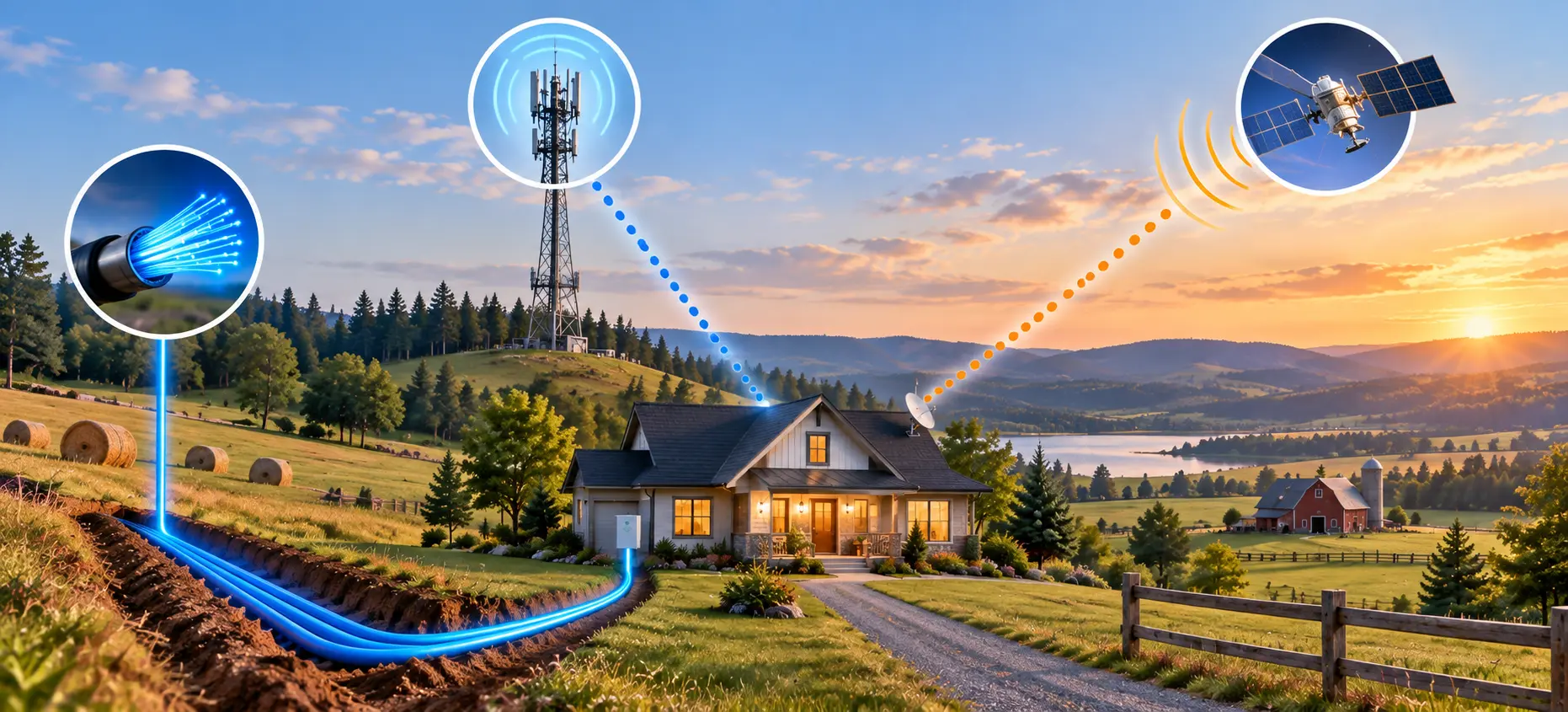
Fibre internet uses fibre-optic cables to transmit data.
Rather than relying on traditional copper wiring, information travels through thin strands of fibre using light signals.
Where fibre infrastructure is available, it can support high-speed connectivity for households with demanding internet needs.
The challenge in rural communities is availability. Fibre infrastructure needs to physically reach a community or property, so coverage depends on where networks have been built.
What Is Fixed Wireless Internet?
Fixed wireless delivers internet to a home using a wireless connection between nearby network infrastructure and equipment installed at the customer’s property.
Instead of running a physical cable all the way to the home, the connection travels wirelessly for part of the journey.
For rural areas where running wired infrastructure to every property can be difficult, fixed wireless can provide another way to connect households.
Availability and performance can depend on factors such as network coverage and the individual property.
What About Satellite Internet?
Satellite technology has historically helped connect homes in locations where terrestrial networks don’t reach.
Rather than connecting through a nearby wired or ground-based network, the service communicates using satellites.
This type of technology has played an important role in expanding connectivity to remote locations.
And What Exactly Is Wi-Fi?
Here’s one of the most common points of confusion:
Your internet connection and your Wi-Fi are not the same thing.
Your internet service brings connectivity to your home.
Your router then uses Wi-Fi to distribute that connection wirelessly to devices throughout the house.
That’s why you can have a good internet connection but still experience weak Wi-Fi in certain rooms.
Why Can’t Everyone Get the Same Service?
Rural Canada is enormous, and every property is different.
Network infrastructure, geography, technology availability, and location can all affect which internet services are available at a particular address.
That’s why checking availability at the individual address is so important.
Understanding Your Options
There isn’t one technology that describes all rural internet.
As networks continue to evolve, different technologies help connect different communities.
Understanding how those technologies work can make it easier to ask the right questions and understand the options available where you live.
Xplore focuses on connecting rural Canadians through technologies designed to reach communities beyond Canada’s major urban centres.


